Moovit
Fitness made for everybody
Moovit is an at-home workout app tailored for people with physical and/or mental mobility restrictions. I came up with this concept as a project for the course I completed where the gave us the task of designing for social good. As someone who enjoys going to the gym multiple times a week, I wanted to find a way to make physical activity accessible for everyone.
Project Overview
Product
Moovit is an at-home fitness app designed specifically for individuals with physical or mental mobility restrictions.
Timeline
August 2024 - January 2025
My Role
I was the sole researcher and designer on this project. I conducted all the user research, interviews, competitive audits, created personas, journey maps, and storyboards, and ran usability tests. I also designed all wireframes, prototypes, and mockups.
The Problem
Despite the proven benefits of physical activity, there is a noticeable lack of accessible workout platforms specifically designed for people with mobility limitations
The Goal
To create a motivating and inclusive fitness app that adapts to users’ physical and mental limitations while addressing their individual needs and goals.
Understanding the User
User Research
To better understand our users’ needs, I began by conducting interviews with individuals who experience mobility restrictions. The insights were eye-opening: although most participants were eager to stay active, they faced major challenges with consistency, motivation, and isolation.
Every participant agreed that physical activity positively impacted their lives, but traditional fitness solutions lacked the flexibility or inclusiveness needed for them to succeed.
Key Pain Points
Accessibility: Most existing workout apps assume users have full mobility and don’t cater to people with physical or mental limitations.
Insecurity: Many users feel too self-conscious to work out in public spaces like gyms, especially when dealing with visible disabilities or anxiety.
Lack of Community: Users expressed feelings of isolation and believed a supportive community could greatly improve their fitness journey.
Generic Programs: Existing workouts are not customizable or safe for people with unique health conditions and varied mobility levels.
Personas
To better empathize with our users, I created two personas:
The first, Jamie Walker is living with multiple sclerosis. She’s active and community-oriented but struggles to find workout programs that accommodate her needs.
The second, Sam Green. He doesn’t have a physical disability but deals with severe social anxiety, making it difficult to stay consistent with workouts. He prefers working out alone but still craves motivation and structure.
User Journey Mapping
Creating journey maps helped me step into the shoes of our users and identify real-world friction points in their fitness journeys. Since there are few accessible fitness apps, I mapped out a common scenario—visiting a gym for the first time—to highlight the stress and uncertainty users experience. These insights reinforced the importance of developing an at-home solution like Moovit.
Competitive Audit
I analyzed existing solutions to evaluate what’s working, what’s missing, and where Moovit can stand out.
Unfortunately, very few apps serve users with mobility restrictions. The only direct competitor I found was Accessercise, and even that app wasn’t fully functional.
This gap in the market highlighted clear opportunities:
- Focus on accessible at-home workouts.
- Offer personalized programs based on individual health conditions.
- Build a sense of community for users facing similar challenges.
Audit Sheet
Design Process
Wireframing
I skipped paper wireframes and went straight to digital since I had a strong initial vision for the layout. Creating wireframes helped me grasp the scope of the project and focus on essential UX elements early on.
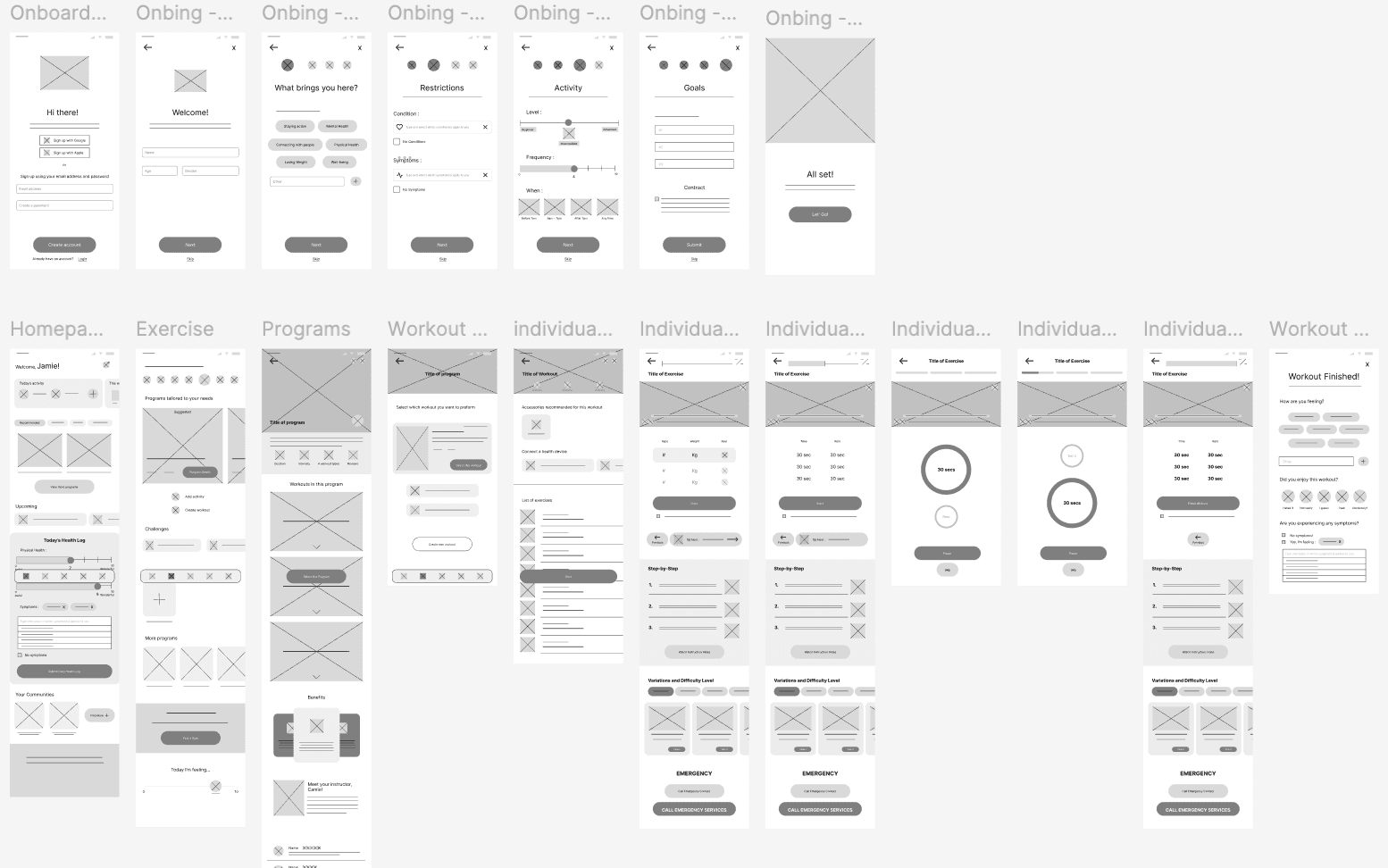
Low-fidelity Prototypes
Even without visuals, a good product should feel intuitive. Building the low-fidelity prototype was a chance to test the logic of user flows and navigation, stripped of distractions.
Usability Study #1
In our first usability test, I learned a lot about minor UX improvements that make a big difference.
2/5
users mentioned wanting a progress bar during the onboarding process
3/5
users wanted to have accessibility settings at the start of the onboarding
4/5
users need a visual cue when adding items to their favourites
Key Pain Points :
Refining the Design
Mockups
Bringing the design to life was exciting. I chose purple and orange for their emotional impact—purple conveys strength and power, while orange evokes enthusiasm and energy.
I selected a bold, italicized font to give the interface a dynamic, sporty feel. Creating the Moovit logo was a proud moment—it’s my first logo design, and I believe it represents our accessibility-first approach beautifully.
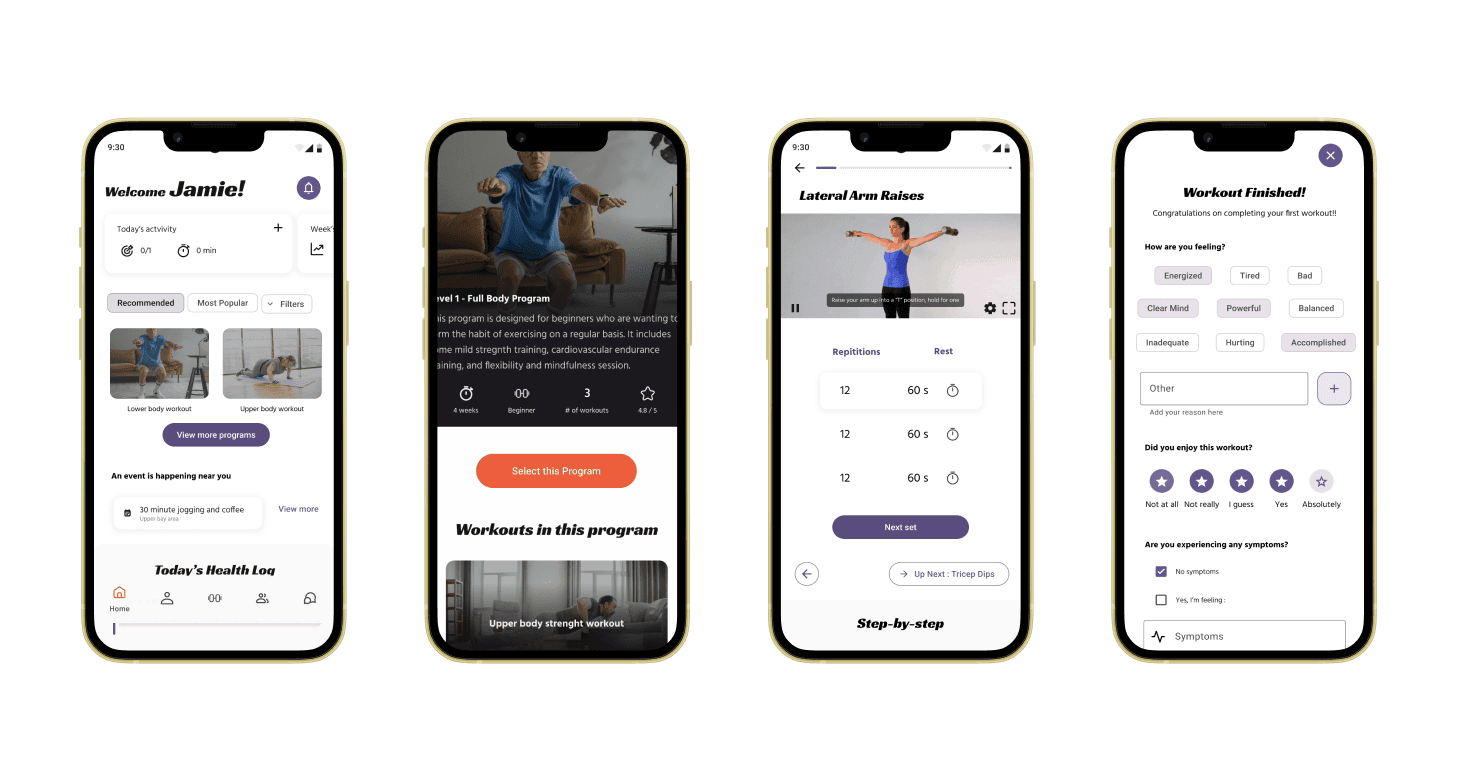
Usability Study #2
This second round of testing involved new participants to validate improvements.
Results : All previous issues were resolved, and users responded positively to the app’s clean layout and design. No new problems were reported.
High-fidelity Prototype
The high-fidelity prototype brought everything together!

Going Forward
Takeaways
Impact :
Moovit has the potential to make a real difference. Creating a fitness app that serves people with mobility limitations is an overlooked but vital opportunity.
What I Learned :
Designing for social good is one of the most rewarding aspects of being a UX designer. Prioritizing accessibility and empathy leads to more meaningful products.
Challenges : My biggest challenge was scope creep. I wanted to include too many features too soon. My product management training helped me realize that a good product starts simple. The focus should remain on solving the core problem: helping users exercise consistently and confidently.
Nest Steps
Expand Platform Compatibility : Adapt designs for tablets and desktops to accommodate users who need larger screens.
Build the Community Page : Allow users to support each other by sharing milestones, motivating one another, and connecting.
Offer Meal Plans : Personalized meal plans based on health conditions and dietary restrictions will help users build a complete, healthy lifestyle.